Produced by Crown International Pictures, 1977s The Van is a sex comedy focusing on the exploits of recent high school grad Bobby, played by Stuart Goetz who a few years ealier was seen as the nice guy who Marcia blows off for a football player on a 1973 episode of The Brady Bunch.
Bobby lusts for the shapely blonde Sally but her current beau, tattooed tough guy Dugan is not amused by Bobby's interest. Bobby works at a car wash, where his boss (Danny DeVito) also sidelines as a bookmaker. Along the way, Bobby gets into goofy shenanigans, eventually purchases his dream van, and continues to get into R-rated hijinks in his quest for sex.
The van itself is quite a sight. A heavily tricked out and customized 1977 Dodge D300 Tradesman van, extras found inside include a waterbed, mirrored ceiling, an eight-track player, and a toaster; among other items. It also sports a custom paint job, with "Straight Arrow" emblazoned on both sides.
Musician Sammy Johns provides material for the soundtrack, including his 1975 hit single "Chevy Van" even though Bobby's van is a Dodge. Actor Stephen Oliver would return in his role as tough guy/bully Dugan in Crown International Pictures 1978 feature Malibu Beach.
The Hills Have Eyes (1977) was the first Wes Craven movie I ever saw when it aired in the Chicago area on an over the air, descrambler needed, pre-cable system called ONTV sometime in the late 70s/early80s. A bunch of the movies I caught on that system have remained favorites, such as The Wicker Man or The Children. Both on the movie poster and in the film, Michael Berryman left quite an impression as well and remains a favorite actor who brings much to all his film roles.
The 1977 film Shock Waves would make a great double feature with Death Ship since they both deal with Nazi inspired supernatural terror on and near the high seas.
First viewed this when it aired on Night Flight in the 1980s. Director Ken Wiederhorn (King Frat, Eyes of a Stranger, Meatballs 2, Return of the Living Dead 2) does a superb job creating tension and terror on a very low budget. Brooke Adams along with horror veterans
Peter Cushing and John Carradine are the most notable faces in the film.
They story follows a group of vacationers who charter a boat to tour, fish, and dive around some Caribbean Islands. The weather becomes odd, the boat collides with a mystery freighter, and the hull is damaged. This forces the crew and passengers to seek refuge on a small island where they encounter Peter Cushing's character and things take a terrifying turn for the worse.
With footage from 1977, this documentary focuses on the CBGB punk rock scene with interviews and performances from The Ramones, Blondie, and the Dead Boys plus those around them; such as CBGB owner/Dead Boys manager Hilly Kristal.
Here's a favorite of mine, Sorcerer. It's William Friedkin's 1977 remake of Henri-Georges Clouzot's 1953 film The Wages of Fear.
Roy Scheider (who portrays a low level American criminal) leads an international cast of characters each with their own deadly, grievous reasons to have relocated to a small town in a rather hostile South American country. But a chance for an extraction anywhere else is presented when financial reward is offered as compensation for those driving truckloads of ancient nitroglycerin through thick jungles and threatening mountains. It's a wild ride, best seen on the big screen and worthy of a viewing.
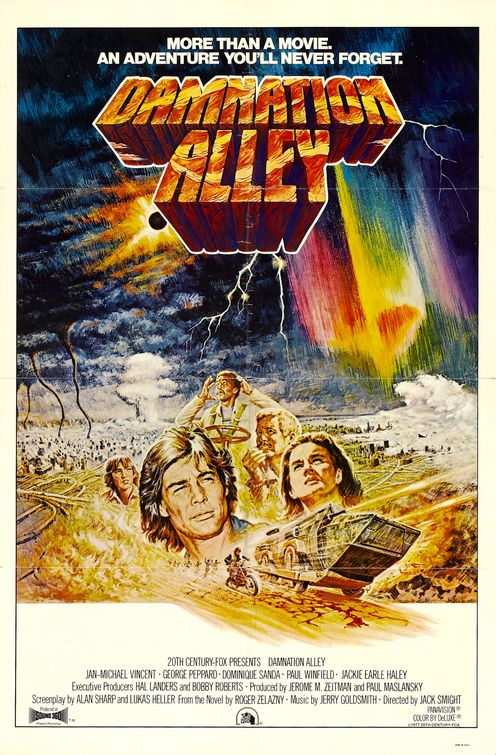
Roger Zelazny’s novel Damnation Alley (1967) was used as source material, but as is often the case, the 1977 film version did not necessarily follow the book to the letter.
Promising huge special effects along with science fiction action, the film was released five months after Star Wars had already captured that audience by the bucketful and had also truly delivered with spectacular creatures and ground breaking special effects. Damnation Alley did poorly at the box office and was quickly pulled and repackaged on a double bill with Ralph Bakshi's Wizards (1977). Curious side note: the film's "Landmaster" later made a cameo in Chris Elliott's sitcom Get a Life as the Paperboy 2000.
Tobe Hooper's next film after The Texas Chainsaw Massacre was 1977s Eaten Alive. I've alway dug this film and feel that it is unfairly derided by some critics and deserves attention/viewings as a prime example of American exploitation/grindhouse movie making.
The story centers around a grimy, decrepit hotel built next to a swamp/river which is run by the scenery chewing and increasingly unhinged Neville Brand, who takes care of evil folks with his trusty scythe and crocodile pal. Film veterans Mel Ferrer, Carolyn Jones and Stuart Whitman also appear in the film; as does Texas Chainsaw Massacre alumn Marilyn Burns plus a pre-Freddy Krueger Robert Englund as Buck. No explanations are provided as to the caretakers background and this adds to the slightly off and surreal nightmare -esque atmosphere. Tobe Hooper helped create the soundtrack, a dissonant and electronic score that works well to enhance tension. As it was shifted around for distribution the film was re-titled multiple times, with some alternate titles including: Brutes and Savages, Death Trap, Horror Hotel, Slaughter Hotel, or Starlight Slaughter.
Recently watched the humorous (and recommended) mockumentary Incident at Loch Ness (2004) which was co-written by Werner Herzog and Zak Penn, who was also the director as well as appearing in the film alongside Herzog. Aside from the curious fact that among his other projects Zak Penn was the screenwriter for PCU (1994), I was reminded of the high quality and fascinating actual documentaries Werner Herzog has created throughout the years and La Soufriere is one of my favorites.
La Soufriere takes Herzog and a skeleton crew to the Caribbean island of Guadeloupe as an enormous volcano has begun showing multiple signs than an cataclysmic eruption is imminent. Many years earlier, the volcano had erupted and killed everyone nearby (with one notable exception) and this fact has caused nearly all residents near the volcano to evacuate. He is drawn to the situation and interested in speaking with the one islander who has chosen to remain. The visuals are supplied with beautiful panoramas of rugged and lush landscapes which are contrasted with stark, "after-the-end-of-world" shots of the town completely devoid of humans - but with electricity still powering things such as traffic lights.
The under appreciated 1977 film Sorcerer is a long time favorite from the intriguing director William Friedkin (The French Connection, The Exorcist, Cruising, Bug).
An English language remake of the 1953 French film The Wages of Fear, Sorcerer delivers a gritty and harrowing glimpse of men motivated to push themselves (and their machines) beyond the breaking point. For the most part, I've never much cared for film remakes, but this movie (along with John Carpenter's The Thing) bucks any negative notions about the necessity of such repeated cinematic endeavours and for me, stands out as a classic.
William Friedkin was given a wide creative berth and sizable financing from Universal studios. As the costs for location shooting propelled the films budget skyward, Paramount became involved as a partner. Tensions on set caused some degree of feuding between Friedkin and producer David Salven, who was eventually fired by Friedkin. Clashes with the exacting director resulted in cinematographer Dick Bush quitting halfway through the films principal photography.
The film first introduces the origins of the main characters and illuminates why they find themselves in a remote South/Central American country, hopefully far enough away from the rest of the world as to prevent discovery. We then follow these men through the extreme rigors of survival in this foreign arena, mainly working dangerous manual labor for an oil company. A chance to earn some real money (and more) is produced when an accident at the oil well causes an explosion that cannot be handled. A long neglected cache of volatile nitroglycerin is needed to blow up the rig, but the nitro is miles away with little more than jungle trails between the destinations. After a helicopter transfer is ruled out, the company seeks drivers to transport the explosives on the suicidal end run for both the petro company and the desperate men. An unrelenting hell ride follows, as less than ideal trucks are used and mother nature (plus some very human obstacles) block them at every conceivable angle. In particular, the infamous bridge scene (spotlighted on the film's one sheet) packs a tremendous cinematic punch and is a true spectacle to view and hear, especially in a theater.
The often propulsive or discordant Tangerine Dream score adds to the increasingly high tension on screen. A standout soundtrack that perfectly fits and proved influential as well.
This was Freidkin's next film after 1973s The Exorcist and just prior to 1978s The Brinks Job and 1980s Cruising. It was released a month after Star Wars but garnered little at the box office and was dimissed by some critics, although I remember Siskel and Ebert showcasing the film on an early 80s episode of Sneak Previews devoted to "sleepers" - great movies that you might have missed. Sorcerer has a spot in my all time favorite films.
Director William Friedkin discusses the making of his 1977 film Sorcerer.
(In reference to Sorcerer) "...my favorite of all the films that I have made. It's one of my only films I can watch because it came out almost exactly as I intended." -William Friedkin in William Friedkin: Films of Aberration, Obsession and Reality by Thomas D. Clagett.
the trailers
Betrayal - Tangerine Dream from the Sorcerer Soundtrack
Hugely rocking and influential in equal doses, The Runaways are a sometimes overlooked gem of an American rock band that also counted fans in cutting edge punk outfits like the Sex Pistols and the Germs. Bringing together influences from genres such a heavy metal, glam, punk and rock to create a unique blend was their thing.
Unfortunately they were mainly disregarded by the US radio and music press as the latest gimmick concocted by rock impresario Kim Fowley (even though it was Sandy West and Joan Jett who first presented themselves to Fowley with their ideas and plans for an all girl band), but success came in larger measure in Europe and Japan.
The Runaways sound is a most up front, rocking affair and still stands up well today. They were fronted by the she-Bowie-esque Cherie Currie and gave prominence to the dual riffin' from Joan Jett on rhythm guitar and Lita Ford on lead guitar duties. The rhythm section was populated by bassist Micki Steele and drummer Sandy West. Cannot recommend the first Runaways record enough.
The Runaways Discography * The Runaways (1976), #194 US * Queens of Noise (1977), #172 US * Live in Japan (1977) * Waitin' for the Night (1977) * And Now... The Runaways (1978), international release * Flaming Schoolgirls (1980), compilation * Little Lost Girls (1981), re-sequenced U.S. version of And Now... The Runaways * The Best Of The Runaways (1982) * Born to be Bad (1993), compilation of early demos
a big fan of reading books, all kinds of art, J.G. Ballard, autumn, Dr Pepper, listening to records, women wearing skirts and high heels, exceptionally weird movies, bike riding, diners and other stuff...
Blogspot uses cookies to personalise content and ads, to provide social media features and to analyse our traffic. They also share information about your use of our site with their social media, advertising and analytics partners. See details here.




 Posts
Posts